
PRESSURE TRANSDUCER SIMULATOR by Fogg System Company, Inc.

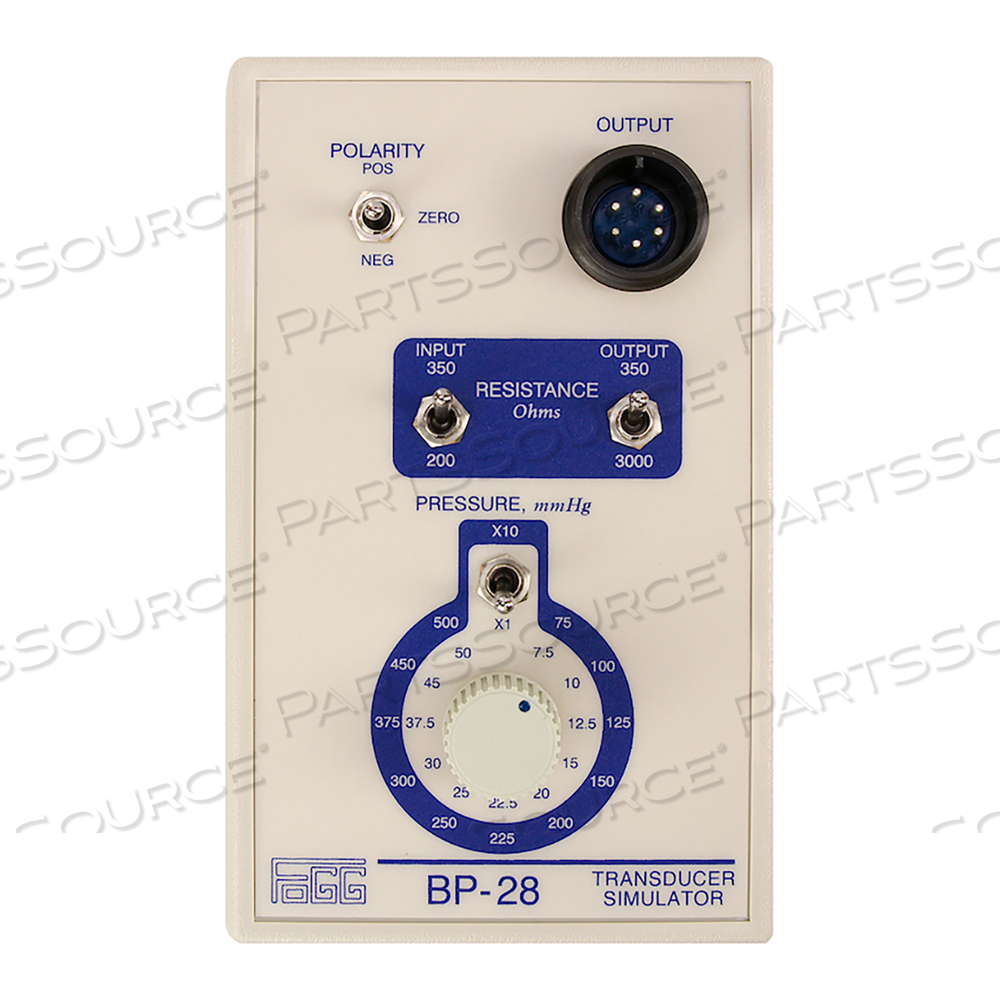
OEM#: BP-28PRESSURE TRANSDUCER SIMULATOR by Fogg System Company, Inc.
The Pressure Transducer Simulator is used to setup, demonstrate and troubleshoot pressure monitors. When substituted for a pressure transducer and a manometer, it provides stable and accurate levels for setup and testing of the monitor. It can be used to quickly determine whether measurement problems are caused by the transducer or the monitor. The simulator is designed for biomedical engineers, technicians, manufacturers and service organizations. It is also useful for training nursing and other health care professionals in the correct setup and operation of pressure monitors, and in the steps required to identify defective transducers. It contains a precision, thermally stable, bridge that simulates the electrical characteristics of pressure transducers used with patient monitors and provides 45 pressure levels from -500 to +500 mmHg. Selectable excitation (input) and signal (output) resistance is used to determine how a monitor functions with a transducer that has an excitation resistance as low as 200 Ohms, a signal resistance as high as 3000 Ohms, or both as defined by the ANSI/AAMI Standard for Blood Pressure Transducers (BP22-1994). Selectable signal resistance can also be used to measure the input impedance of a pressure amplifier.
- Setup, Demonstrate, Troubleshoot
- Simulates 45 calibrated levels from -500 to +500 mmHg
- Accurate within 0.1% of setting +/-0.5 mmHg
- Simulates Excitation (Input) and Signal (Output) resistance limits as defined by the ANSI/AAMI Standard for Blood Pressure Transducers
- Cables are available to connect the Transducer Simulator to most pressure monitors, amplifiers and recording systems
- Accurate within 0.1% of setting +/-0.5 mmHg
- Thermal ZERO Shift: Less than ±0.05 mmHg/°C
- Cables are available to connect the Transducer Simulator to most pressure monitors, amplifiers and recording systems
- Certificate of Conformance traceable to NIST is available
- Output Offset at ZERO: Less than ±0.5 MMHg
- Output Sensitivity Factor: 5 µV/V/MMHg
- Simulated Pressure Accuracy: ±0.1% of setting ±0.5 mmHg, at 25 °C.
- Simulates 45 calibrated levels from -500 to +500 mmHg
- Simulates Excitation (Input) and Signal (Output) resistance limits as defined by the ANSI/AAMI Standard for Blood Pressure Transducers (BP22-1994)
- Thermal Sensitivity Shift: Less than ±0.1 MMHg/°C
The Pressure Transducer Simulator is used to setup, demonstrate and troubleshoot pressure monitors. When substituted for a pressure transducer and a manometer, it provides stable and accurate levels for setup and testing of the monitor. It can be used to quickly determine whether measurement problems are caused by the transducer or the monitor. The simulator is designed for biomedical engineers, technicians, manufacturers and service organizations. It is also useful for training nursing and other health care professionals in the correct setup and operation of pressure monitors, and in the steps required to identify defective transducers. It contains a precision, thermally stable, bridge that simulates the electrical characteristics of pressure transducers used with patient monitors and provides 45 pressure levels from -500 to +500 mmHg. Selectable excitation (input) and signal (output) resistance is used to determine how a monitor functions with a transducer that has an excitation resistance as low as 200 Ohms, a signal resistance as high as 3000 Ohms, or both as defined by the ANSI/AAMI Standard for Blood Pressure Transducers (BP22-1994). Selectable signal resistance can also be used to measure the input impedance of a pressure amplifier.
- Setup, Demonstrate, Troubleshoot
- Simulates 45 calibrated levels from -500 to +500 mmHg
- Accurate within 0.1% of setting +/-0.5 mmHg
- Simulates Excitation (Input) and Signal (Output) resistance limits as defined by the ANSI/AAMI Standard for Blood Pressure Transducers
- Cables are available to connect the Transducer Simulator to most pressure monitors, amplifiers and recording systems
The Pressure Transducer Simulator is used to setup, demonstrate and troubleshoot pressure monitors. When substituted for a pressure transducer and a manometer, it provides stable and accurate levels for setup and testing of the monitor. It can be used to quickly determine whether measurement problems are caused by the transducer or the monitor. The simulator is designed for biomedical engineers, technicians, manufacturers and service organizations. It is also useful for training nursing and other health care professionals in the correct setup and operation of pressure monitors, and in the steps required to identify defective transducers. It contains a precision, thermally stable, bridge that simulates the electrical characteristics of pressure transducers used with patient monitors and provides 45 pressure levels from -500 to +500 mmHg. Selectable excitation (input) and signal (output) resistance is used to determine how a monitor functions with a transducer that has an excitation resistance as low as 200 Ohms, a signal resistance as high as 3000 Ohms, or both as defined by the ANSI/AAMI Standard for Blood Pressure Transducers (BP22-1994). Selectable signal resistance can also be used to measure the input impedance of a pressure amplifier.
- Setup, Demonstrate, Troubleshoot
- Simulates 45 calibrated levels from -500 to +500 mmHg
- Accurate within 0.1% of setting +/-0.5 mmHg
- Simulates Excitation (Input) and Signal (Output) resistance limits as defined by the ANSI/AAMI Standard for Blood Pressure Transducers
- Cables are available to connect the Transducer Simulator to most pressure monitors, amplifiers and recording systems
- Accurate within 0.1% of setting +/-0.5 mmHg
- Thermal ZERO Shift: Less than ±0.05 mmHg/°C
- Cables are available to connect the Transducer Simulator to most pressure monitors, amplifiers and recording systems
- Certificate of Conformance traceable to NIST is available
- Output Offset at ZERO: Less than ±0.5 MMHg
- Output Sensitivity Factor: 5 µV/V/MMHg
- Simulated Pressure Accuracy: ±0.1% of setting ±0.5 mmHg, at 25 °C.
- Simulates 45 calibrated levels from -500 to +500 mmHg
- Simulates Excitation (Input) and Signal (Output) resistance limits as defined by the ANSI/AAMI Standard for Blood Pressure Transducers (BP22-1994)
- Thermal Sensitivity Shift: Less than ±0.1 MMHg/°C
The Pressure Transducer Simulator is used to setup, demonstrate and troubleshoot pressure monitors. When substituted for a pressure transducer and a manometer, it provides stable and accurate levels for setup and testing of the monitor. It can be used to quickly determine whether measurement problems are caused by the transducer or the monitor. The simulator is designed for biomedical engineers, technicians, manufacturers and service organizations. It is also useful for training nursing and other health care professionals in the correct setup and operation of pressure monitors, and in the steps required to identify defective transducers. It contains a precision, thermally stable, bridge that simulates the electrical characteristics of pressure transducers used with patient monitors and provides 45 pressure levels from -500 to +500 mmHg. Selectable excitation (input) and signal (output) resistance is used to determine how a monitor functions with a transducer that has an excitation resistance as low as 200 Ohms, a signal resistance as high as 3000 Ohms, or both as defined by the ANSI/AAMI Standard for Blood Pressure Transducers (BP22-1994). Selectable signal resistance can also be used to measure the input impedance of a pressure amplifier.
- Setup, Demonstrate, Troubleshoot
- Simulates 45 calibrated levels from -500 to +500 mmHg
- Accurate within 0.1% of setting +/-0.5 mmHg
- Simulates Excitation (Input) and Signal (Output) resistance limits as defined by the ANSI/AAMI Standard for Blood Pressure Transducers
- Cables are available to connect the Transducer Simulator to most pressure monitors, amplifiers and recording systems
The Pressure Transducer Simulator is used to setup, demonstrate and troubleshoot pressure monitors. When substituted for a pressure transducer and a manometer, it provides stable and accurate levels for setup and testing of the monitor. It can be used to quickly determine whether measurement problems are caused by the transducer or the monitor. The simulator is designed for biomedical engineers, technicians, manufacturers and service organizations. It is also useful for training nursing and other health care professionals in the correct setup and operation of pressure monitors, and in the steps required to identify defective transducers. It contains a precision, thermally stable, bridge that simulates the electrical characteristics of pressure transducers used with patient monitors and provides 45 pressure levels from -500 to +500 mmHg. Selectable excitation (input) and signal (output) resistance is used to determine how a monitor functions with a transducer that has an excitation resistance as low as 200 Ohms, a signal resistance as high as 3000 Ohms, or both as defined by the ANSI/AAMI Standard for Blood Pressure Transducers (BP22-1994). Selectable signal resistance can also be used to measure the input impedance of a pressure amplifier.
- Setup, Demonstrate, Troubleshoot
- Simulates 45 calibrated levels from -500 to +500 mmHg
- Accurate within 0.1% of setting +/-0.5 mmHg
- Simulates Excitation (Input) and Signal (Output) resistance limits as defined by the ANSI/AAMI Standard for Blood Pressure Transducers
- Cables are available to connect the Transducer Simulator to most pressure monitors, amplifiers and recording systems
- Accurate within 0.1% of setting +/-0.5 mmHg
- Thermal ZERO Shift: Less than ±0.05 mmHg/°C
- Cables are available to connect the Transducer Simulator to most pressure monitors, amplifiers and recording systems
- Certificate of Conformance traceable to NIST is available
- Output Offset at ZERO: Less than ±0.5 MMHg
- Output Sensitivity Factor: 5 µV/V/MMHg
- Simulated Pressure Accuracy: ±0.1% of setting ±0.5 mmHg, at 25 °C.
- Simulates 45 calibrated levels from -500 to +500 mmHg
- Simulates Excitation (Input) and Signal (Output) resistance limits as defined by the ANSI/AAMI Standard for Blood Pressure Transducers (BP22-1994)
- Thermal Sensitivity Shift: Less than ±0.1 MMHg/°C
The Pressure Transducer Simulator is used to setup, demonstrate and troubleshoot pressure monitors. When substituted for a pressure transducer and a manometer, it provides stable and accurate levels for setup and testing of the monitor. It can be used to quickly determine whether measurement problems are caused by the transducer or the monitor. The simulator is designed for biomedical engineers, technicians, manufacturers and service organizations. It is also useful for training nursing and other health care professionals in the correct setup and operation of pressure monitors, and in the steps required to identify defective transducers. It contains a precision, thermally stable, bridge that simulates the electrical characteristics of pressure transducers used with patient monitors and provides 45 pressure levels from -500 to +500 mmHg. Selectable excitation (input) and signal (output) resistance is used to determine how a monitor functions with a transducer that has an excitation resistance as low as 200 Ohms, a signal resistance as high as 3000 Ohms, or both as defined by the ANSI/AAMI Standard for Blood Pressure Transducers (BP22-1994). Selectable signal resistance can also be used to measure the input impedance of a pressure amplifier.
- Setup, Demonstrate, Troubleshoot
- Simulates 45 calibrated levels from -500 to +500 mmHg
- Accurate within 0.1% of setting +/-0.5 mmHg
- Simulates Excitation (Input) and Signal (Output) resistance limits as defined by the ANSI/AAMI Standard for Blood Pressure Transducers
- Cables are available to connect the Transducer Simulator to most pressure monitors, amplifiers and recording systems